English
 Deutsch
 Español
 Italiano
 Nederlands
 Português
 日本語
 한국어
 简体中文
 繁體中文


Table of contents:
This guide is for first-time visitors who want to understand how trains work in Japan: which companies run them, which types of train you will see, and how the Japan Rail Pass fits in. Japan boasts an intricate web of railways that can take visitors to many of their desired destinations. Trains in Tokyo, Osaka, and Nagoya are so efficient that many city dwellers get by without a car. For some visitors, driving in a new country with different rules can be overwhelming, especially if tourists decided to visit Japan during the rainy season. Railways can take the stress off of tourists and allow them to enjoy traveling while keeping themselves and others safe.
Japan has three types of trains, including:
-
Shinkansen: Bullet trains that can travel long distances at high speed, and are known for their comfort. On the Tokaido Shinkansen (Tokyo to Osaka) there are three types of service: Nozomi, Hikari, and Kodama. Other lines use other names, such as Hayabusa, Komachi, Kagayaki, and Sakura. Nozomi and Mizuho trains are not covered by the Japan Rail Pass;
-
JR Trains: Shorter, efficient train lines that are divided by region;
- Private Lines: Trains owned by private networks with quality service.
Railways in Japan are also clean and orderly, and local trips are often inexpensive. Public transportation is sometimes thought of as dirty or stressful, but because of Japan’s social etiquette, it is generally a calm environment. No matter the reason for visiting Japan, it is important to know the kinds of transportation and which is the most effective means for navigating the country.
Japan Train Lines
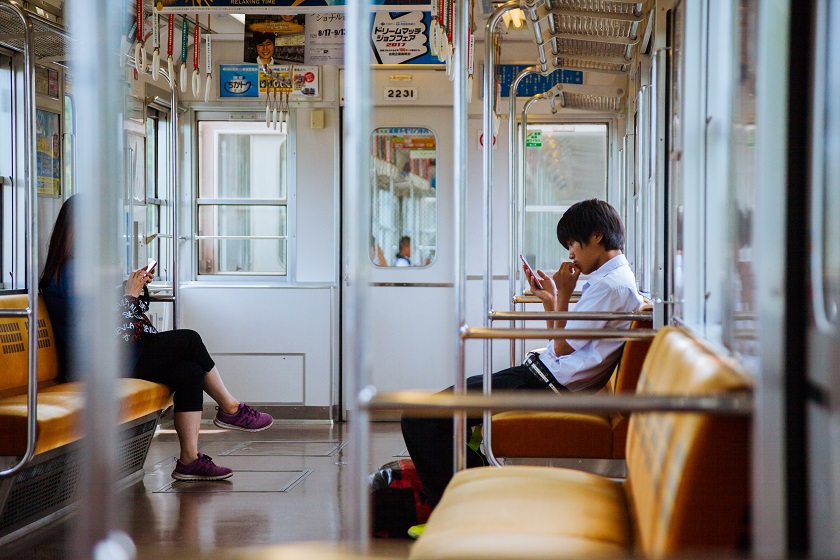
Most of the train lines in Japan are owned by the Japan Railway Group (JR Group). The rest are major private railways, which is why tourists might see differing prices on some train lines. It is also important to note that fares are in the Japanese currency yen, instead of U.S. dollars — knowing the exchange rate will be very helpful. The JR Group operates six passenger railway companies which are defined by region (plus a freight company), however, many of these companies operate outside of their regions as long-distance train services.
Japan’s Railway Business Act divides railway businesses into three types:
-
Type I: companies that provide passenger or freight transport;
-
Type II: companies that provide transport on tracks they did not build themselves;
- Type III: companies that build railway tracks and then transfer them to a Type I operator or let a Type II operator use them.
This system allows different companies to build the tracks and to run the trains on them.
Central Japan Railway Company
The Central Japan Railway (JR Central) operates the Tokaido Shinkansen and the local railways around Nagoya. It runs through the Tokaido corridor, a hub that includes cultural, historical, and industrial aspects of Japan.
- Category: 1;
- Route: Tokyo to Osaka;
- Fees: Shinkansen and limited express trains charge a supplement on top of the regular fare.
East Japan Railway Company
The East Japan Railway Company is the largest of the JR Group companies and manages most of the JR trains in Tokyo and the greater Tokyo area. Its Shinkansen lines also serve many other destinations, including Sendai, Morioka, Akita, Niigata, and Joetsu Myoko.
- Category: 1
- Route: Tokyo to Shin-Aomori
Hokkaido Railway Company
The Hokkaido Railway, also known as the JR Hokkaido, runs most of the intercity rail services in Hokkaido, as well as the Hokkaido Shinkansen from Shin-Aomori to Shin-Hakodate-Hokuto. The extension to Sapporo has been delayed until at least the end of fiscal year 2038. The south route runs through many popular tourist spots, like Onuma Quasi National Park and Lake Toya.
- Category: 1
- Route: Sapporo to Hakodate;
Kyushu Railway Company
The Kyushu Railway operates the intercity railway services in Kyushu. The train can take visitors to destinations like the Kumamoto Castle, or Mount Aso (check the current status of the Hohi Line before you go). The Kyushu Shinkansen runs from Fukuoka’s Hakata Station to Kagoshima, and the Nishi-Kyushu Shinkansen connects to Nagasaki.
- Category: 1;
- Route: Fukuoka to Kagoshima;
Shikoku Railway Company
The Shikoku Railway, or JR Shikoku, is the smallest of Japan’s railways. It operates intercity and local rail services in the four prefectures on the island. Trains also connect Shikoku with Honshu over the Seto-Ohashi Bridge, so you can reach the island without a ferry.
- Category: 1;
- Route: Kojima to Kochi;
West Japan Railway Company
The West Japan Railway operates in Western Honshu. The train runs a popular line called the Urban Network, which runs trains in Kyoto and through Osaka and Kobe. This network is so popular, it is known to run trains every few minutes during peak times. Even though the biggest route is through the Urban Network, other lines make up more than half of JR West’s train lines. These are mainly used for business travelers from smaller cities.
- Category: 2;
- Route: Osaka to Hakata (Fukuoka) on the Sanyo Shinkansen; Joetsu Myoko to Tsuruga on the Hokuriku Shinkansen (extended from Kanazawa to Tsuruga on 16 March 2024)
Japan Railway Map

See our map page for the full interactive map of the JR Rail Network.
Japan Rail Pass – Interactive Map
Utilizing Transportation Systems In Japan
There are a variety of transportation options and types of passes available when travelling throughout Japan, including:
- Buses are rarely used in Japan due to the metro system, but they could be a less expensive option if tourists utilize a night coach instead of a hotel;
- Ferries are extensive and efficient in Japan. Many of the smaller islands can only be reached by ship.
- Subways in Japan are always punctual, safe, and the preferred mode of transportation in cities like Tokyo.
- IC Cards, such as Suica, PASMO, and ICOCA, are rechargeable cards that can be used to pay fares on public transportation in most major cities. They can also be used in some shops and restaurants. The cards available to visitors have changed in recent years, so check the current options before you travel.
- The Japan Rail Pass is available for 7, 14, or 21 consecutive days and can be used on most JR trains, including most Shinkansen (but not Nozomi or Mizuho), as well as other services run by JR. It does not cover subways, private railways, or city buses, and it is most economical when you plan several long-distance trips. Regional passes are also available.
Public transportation can be overwhelming in a foreign country. It helps to have a navigation or train-route app on your phone, along with mobile data (an eSIM or a pocket Wi-Fi), in case you get lost on your adventures. However, Japan’s train system is so intricate and efficient that it is very likely a tourist can navigate public transportation.
FAQs
1. What types of trains are there in Japan?
There are Shinkansen (bullet trains) for long distances, JR trains for regional and local travel, and private railways that run local and suburban routes.
2. Who runs the trains in Japan?
Most lines belong to the JR Group, which has six passenger railway companies divided by region: JR Hokkaido, JR East, JR Central, JR West, JR Shikoku, and JR Kyushu. Other lines are run by private railways and subway operators.
3. What are the names of the Shinkansen trains?
On the Tokaido Shinkansen, the services are Nozomi, Hikari, and Kodama. Other lines use other names, such as Hayabusa on the Tohoku Shinkansen, Komachi on the Akita Shinkansen, Kagayaki on the Hokuriku Shinkansen, and Sakura and Mizuho on the Sanyo and Kyushu Shinkansen.
4. Does the Japan Rail Pass cover all trains in Japan?
No. The Japan Rail Pass covers most JR trains, including most Shinkansen, but not Nozomi and Mizuho trains. It does not cover subways, private railways, or city buses.
5. Do I need an IC card in Japan?
It is not required, but an IC card such as Suica, PASMO, or ICOCA makes it easier to pay for subways, buses, and some shops. Check the current options for visitors before you travel.
6. Is it easy to travel around Japan without a car?
Yes. In cities such as Tokyo, Osaka, and Nagoya, trains are so efficient that many residents get by without a car, and the rail network can take you to most major destinations.