Deutsch
 Español
 Français
 Italiano
 Nederlands
 Português
 日本語
日本語 한국어
한국어 简体中文
简体中文 繁體中文
繁體中文


The Kyushu Shinkansen (九州新幹線 Kyūshū Shinkansen) is the high speed bullet train line from Hakata down to Kagoshima-Chuo in the south of Kyushu. It connects to the Sanyo Shinkansen at Hakata station and shares many of the trains that come or go from Shin-Osaka.
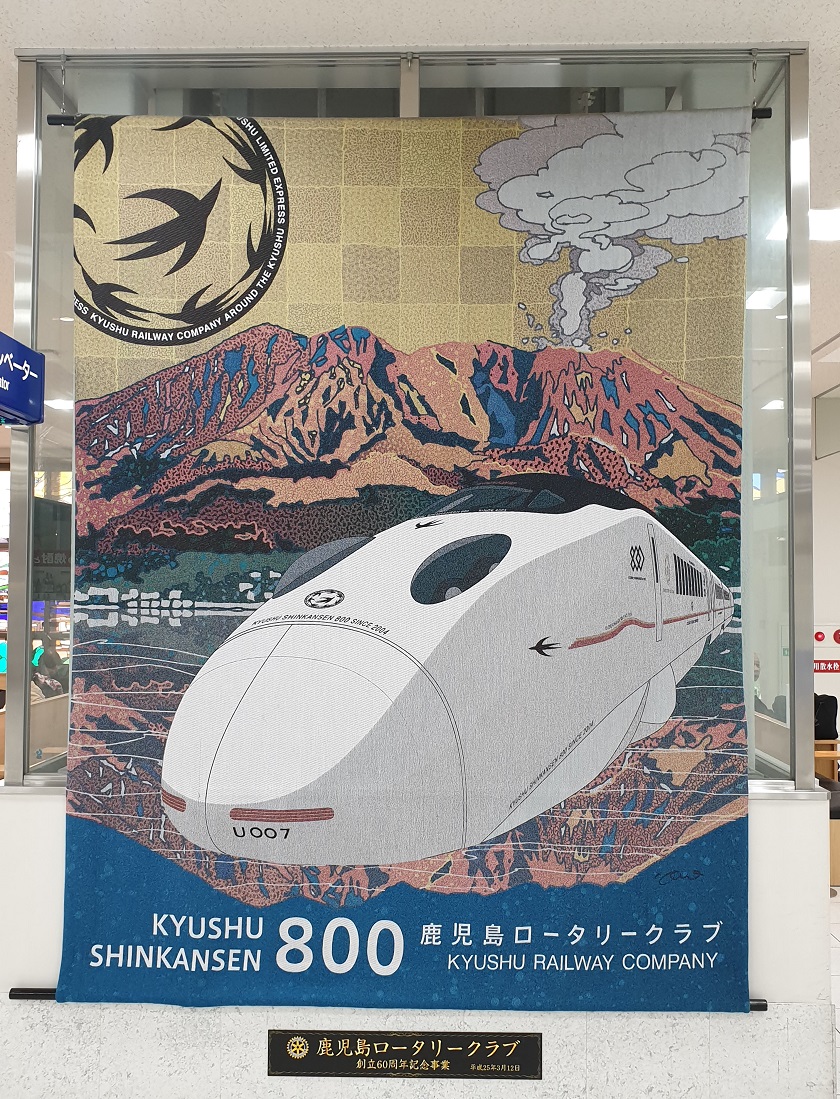
Brief history of the Kyushu Shinkansen
Initial wishes for a Shinkansen line in Kyushu date back as far as the 1950s, but it was only in 1991 that construction began, and the first segment between Kagoshima and Shin-Yatsushiro opened on 13 March 2004. At this point, the Shinkansen service was available up to Shin-Yatsushiro, but passengers had to change trains to a relay train up to Hakata. At Hakata, passengers again had to change trains bound for the Sanyo area.
It was only in 2011 that the full line opened. Reducing the travel time from Hakata – Kagoshima to only 1 hour and 20 minutes, down from the 4+ hours on the conventional railways.
Train services on the Kyushu Shinkansen
There are three train services on the Kyushu Shinkansen. These are:
Mizuho
The fastest service between Shin-Osaka and Kagoshima-chuo stations. The Mizuho stops only at the most important stations; within Kyushu, that means just Hakata, Kumamoto and Kagoshima-Chūō. Since October 2023, JR Pass holders can also ride the Mizuho by paying a supplementary fare (previously, it wasn't available with the pass at all). The regional JR Kyushu Rail Pass, meanwhile, covers the Mizuho with no supplement.
Sakura
The Sakura service is the same train as the Mizuho, but makes a few more stops along the route and is in service between Shin-Osaka and Kagoshima-chuo station. The time difference with the Nozomi/Mizuho is often minimal. In addition to the Mizuho stops, the Sakura stops at stations like Shin-Kobe, Himeji and Kumamoto.
Tsubasa
The Tsubasa is a relay or shuttle service, stopping at every station along the Kyushu Shinkansen, and is used to access the smaller stations. Most Tsubasa services are only in service between Hakata and Kumamoto.
Can I use the JR Pass on the Kyushu Shinkansen?
The Japan Rail Pass is valid on the entire Kyushu Shinkansen line. One thing of note is that the Mizuho service on the Kyushu Shinkansen is not included in the JR Pass. However, the Sakura and Tsubasa train services are included. Seat reservations for the Kyushu Shinkansen can be made for free using the JR Pass at any JR station nationwide.
Regional JR Passes on the Kyushu Shinkansen
All available Kyushu rail passes include the Kyushu Shinkansen (within their area of validity), these are: All Kyushu Area Pass, the Northern Kyushu Area Pass, and the Southern Kyushu Area Pass.
Additionally, the Sanyo-San’in Northern Kyushu Pass is valid on the Kyushu Shinkansen up to Kumamoto.
Green Class on the Kyushu Shinkansen
Green class (or 1st Class) carriages are available on most Kyushu Shinkansen trains, except for some of the Tsubame services. Trains operate a 2×2 seating plan in Green Class, while ordinary cars operate a 3×2 seating plan. Green seats come with extra comfort, reclining and space. It is generally a lot quieter and a good way to escape from the travelling crowds on busy days.
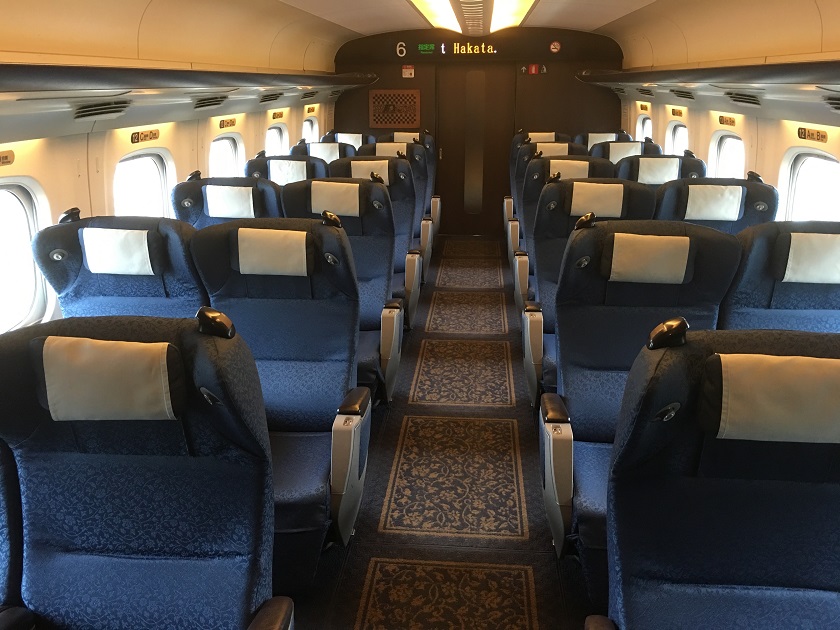
Green Seating on the Sanyo and Kyushu Shinkansen
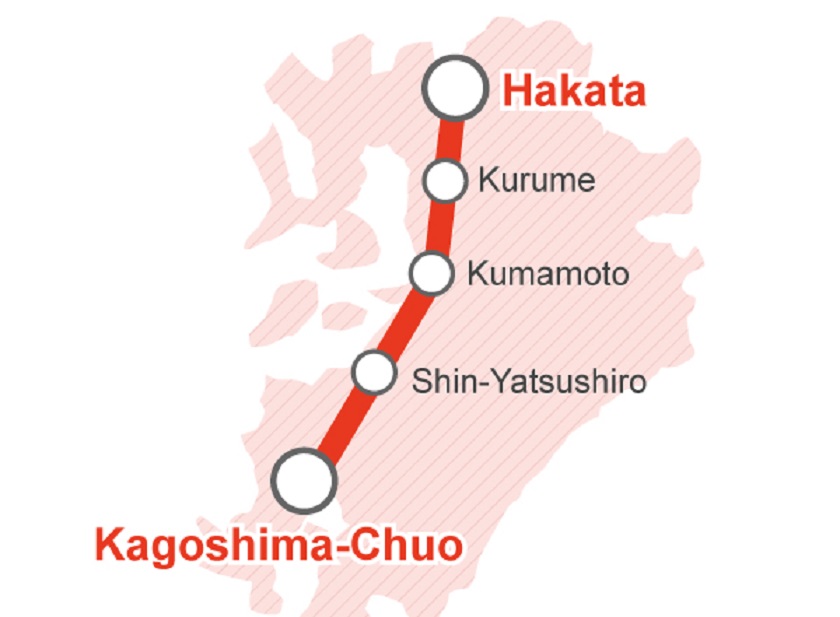
Map of the Kyushu Shinkansen
Below is a map of the Kyushu Shinkansen that includes the most important stops.
The Nishi Kyushu Shinkansen (to Nagasaki)
Kyushu now has a second bullet-train line: the Nishi Kyushu (West Kyushu) Shinkansen, which opened on 23 September 2022. The Kamome trains run between Takeo-Onsen and Nagasaki (around 66 km). For now, this section isn't yet physically linked to the main Kyushu Shinkansen network, so travelling from Hakata to Nagasaki means taking the Relay Kamome limited express from Hakata to Takeo-Onsen, then transferring across the platform to the Kamome shinkansen — a total journey of roughly 90 minutes. Both legs are fully covered by the Japan Rail Pass, with free seat reservations. A future extension to close the gap (between Shin-Tosu and Takeo-Onsen) remains under political discussion, with no confirmed opening date. For more, see our guide to the Nagasaki Shinkansen.
WiFi on the Kyushu Shinkansen
JR Kyushu is slowly introducing free WiFi on the Kyushu Shinkansen, so passengers who travel between Hakata and Kagoshima-Chuo can stay connected. This is mostly limited to high-speed Shinkansen that are shared with JR West, such as the Sakura and Mizuho Shinkansen. Free onboard WiFi is now available on the Kyushu Shinkansen, though the connection is generally limited to open sections and won't work inside the line's many tunnels.
Should you wish to make use of unlimited WiFi with a guaranteed connection, then we recommend using a Pocket WiFi in Japan, which can be connected to any WiFi-capable device.
Frequently asked questions
1. Is the Kyushu Shinkansen covered by the JR Pass?
Yes. The Sakura and Tsubame services and the Nagasaki-line Kamome are fully covered by the nationwide JR Pass, with free seat reservations. The faster Mizuho requires a small supplement (since October 2023). The regional JR Kyushu Rail Pass covers all of them, including the Mizuho, with no supplement.
2. How fast is the Kyushu Shinkansen, and what is the top speed of a shinkansen?
The Kyushu Shinkansen runs at up to 260 km/h. Elsewhere in Japan, N700-series trains on the Tōkaidō and Sanyo lines run at 285–300 km/h, while the fastest scheduled shinkansen is the Tōhoku line's Hayabusa at 320 km/h.
3. What is the ALFA-X, and how fast is it?
The ALFA-X is an experimental test train built by JR East to develop faster future services on the Tōhoku Shinkansen — so it's not a Kyushu train. It has reportedly run at around 400 km/h in testing, with a targeted service speed of roughly 360 km/h in the coming years. (Worth confirming against JR East for the latest figures.)
4. How much does a shinkansen ticket cost?
There's no single price — fares depend on the distance, the seat class (Ordinary or Green), and whether you reserve. Rather than rely on a fixed figure, use our JR Fare Calculator for your specific route. With a JR Pass, there's no per-journey fare at all, aside from the supplement for Nozomi/Mizuho.
5. How do you get to Nagasaki by shinkansen?
Take the Relay Kamome limited express from Hakata to Takeo-Onsen, then transfer across the platform to the Kamome shinkansen onto Nagasaki — about 90 minutes in total, and fully covered by the JR Pass.
.png)