Deutsch
 Español
 Français
 Italiano
 Nederlands
 Português
 日本語
日本語 한국어
한국어 简体中文
简体中文 繁體中文
繁體中文


The JR Yamanote Line (山手線) is Tokyo in a single loop. Running in a circle around the heart of the city, it connects virtually every major district and transit hub — Shinjuku, Shibuya, Ikebukuro, Ueno, Akihabara, Tokyo Station — stopping at 30 stations across 34.5 km of track. For visitors, it's the closest thing to a ready-made city tour.
The Yamanote Line also connects with the JR Chuo Line at both Tokyo and Shinjuku stations — together, the two lines form the backbone of JR travel across central Tokyo.
Nearly every visitor to Tokyo uses the Yamanote Line, often multiple times a day. Understanding how it works means you can move around the city with genuine confidence.
Nearly every visitor to Tokyo will have been on the Yamanote line at least once (much more likely) and understanding the line will help you navigate Tokyo like a pro!
What is the JR Yamanote line?
Quick Answer: The JR Yamanote Line is a circular commuter rail line in central Tokyo operated by JR East. It has 30 stations, covers 34.5 km, and completes a full loop in approximately 60 minutes. All services are local — every train stops at every station. The line is fully covered by the Japan Rail Pass.
The Yamanote is one of the busiest rail lines in the world, with daily ridership reaching several million passengers. On the map and in real life, it's unmistakable: the line is represented in green, and the lime-green trains have become one of the most recognisable symbols of Tokyo.
As of January 2020, all Yamanote Line services are operated exclusively by 50 E235 series trains — a fleet introduced progressively from 2015 and now running exclusively on the loop. These trains feature digital information displays in multiple languages, wide doors, and spacious interiors designed to handle high passenger volumes.
2025 marks the 100th anniversary of the Yamanote Line completing its loop — the final stretch between Ueno and Kanda was added in 1925, transforming what had been a linear line into the circular route we know today. A century of uninterrupted service through the heart of Tokyo.
Train services on the JR Yamanote line
Only local services run on the Yamanote Line — every train stops at every station. There are no rapid or express variants, which keeps navigation simple. Frequency is exceptional: during busy periods, trains run every two to three minutes in each direction. Off-peak, the gap widens to around five minutes — still extremely regular by any standard.
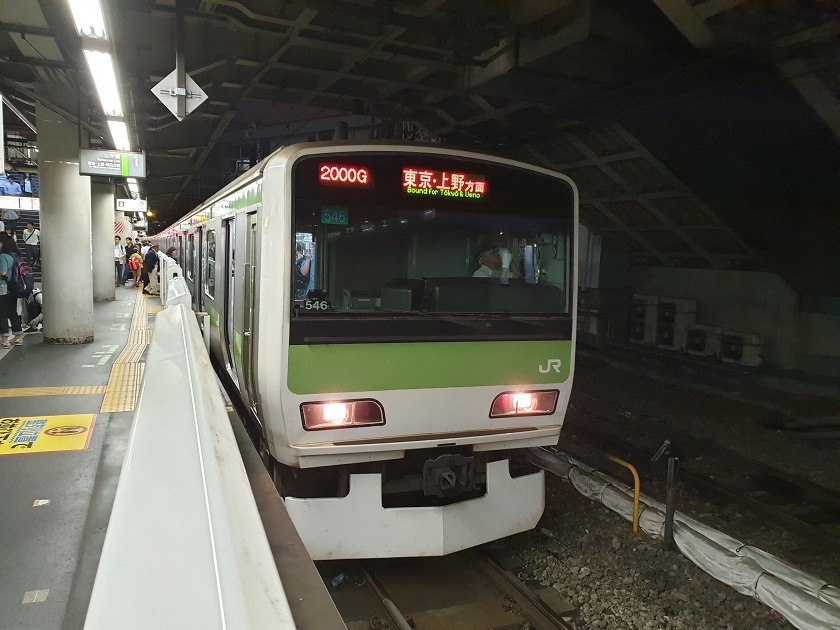
The line operates in both directions simultaneously. Clockwise services run on the outer loop tracks (referred to as the outbound or outer circuit), while anticlockwise services run on the inner tracks (the inbound or inner circuit). Before boarding, check which direction reaches your destination fastest — the difference can be as much as 40 minutes if you're heading the long way round.
The first train of the day departs at 04:26 and the final service runs until 01:04 the following morning, making it one of Tokyo's latest-running lines. The overnight gap, though brief, is important to know if you're out late in a neighbourhood without other transport options.
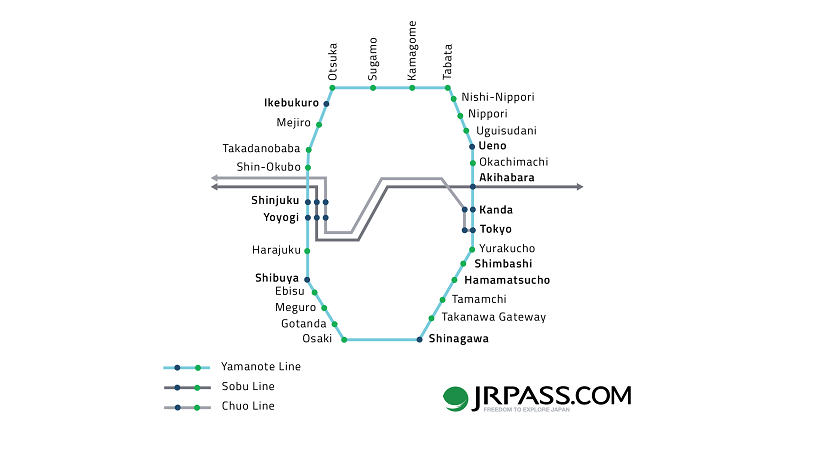
JR Yamanote line map
Below is a map of the JR Yamanote Line in central Tokyo. For the full map of all JR lines across Tokyo and Japan, see our interactive JR Pass Map.
Can I use the Japan Rail Pass on the Yamanote line?
Yes, the JR Yamanote line is fully covered by the JR Pass as there are no seat reservations on local trains, all you have to do is show your pass when entering and exiting the station. Then hop on and off the train as you like :)
All 30 Stations on the Yamanote Line
Running the outer loop of the Yamanote Line, the 30 stations in order are:
-
North side: Nippori – Nishi-Nippori – Tabata – Komagome – Sugamo – Otsuka – Ikebukuro – Mejiro
-
West side: Takadanobaba – Shin-Okubo – Shinjuku – Yoyogi – Harajuku – Shibuya – Ebisu – Meguro – Gotanda
-
South side: Osaki – Shinagawa – Takanawa Gateway (opened 2020) – Tamachi – Hamamatsucho – Shimbashi – Yurakucho
- East side: Tokyo – Kanda – Akihabara – Okachimachi – Ueno – Uguisudani
Key Stations and What to Explore
The Yamanote Line is more than a way to get around — it's a guided tour of Tokyo's most distinct personalities. Each of the major stations has its own character, and knowing what's on the other side of the ticket gate will help you make the most of your time.
Shinjuku — The busiest station on the planet by passenger volume. West of the station: glass towers, the Tokyo Metropolitan Government Building (free observation deck), and some of Tokyo's best ramen. East: Kabukicho entertainment district, the atmospheric Golden Gai bar labyrinth, and Shinjuku Gyoen garden. Budget at least half a day.
Shibuya — Home to the famous scramble crossing, a flood of pedestrians flowing in every direction simultaneously. The surrounding area is a hub of fashion, youth culture and street food. Daikanyama and Nakameguro, both a short walk south, offer a calmer, more boutique Tokyo experience.
Ikebukuro — Tokyo's second-largest commercial district, often overlooked by first-time visitors but beloved by regulars. Sunshine City shopping complex, some of the city's best anime and manga shops, and a more relaxed atmosphere than Shinjuku. Excellent ramen options throughout.
Harajuku — Takeshita-dori is the centre of Tokyo's most theatrical street fashion. A five-minute walk in the other direction leads to the forested calm of Meiji Shrine, one of Tokyo's most serene and rewarding detours from the loop.
Ueno — The cultural hub of the east side. Ueno Park holds several major national museums, a zoo, a beautiful pond, and some of the city's finest cherry blossom viewing in spring. Tokyo National Museum is walking distance from the station.
Akihabara — Electronics, manga, anime and gaming culture packed into a few highly concentrated streets. The neon density is genuinely something to experience even if you're not buying anything.
Tokyo Station — The Shinkansen gateway. Beneath the historic red-brick facade is one of Japan's most complex transfer hubs — and one of its best collections of food shops and station ekiben (rail bento boxes).
Ebisu / Meguro — Quieter, more residential, and increasingly popular with travellers looking for a side of Tokyo that feels lived-in rather than performed. Yebisu Garden Place, a former brewery complex, sits just east of Ebisu station and is worth wandering.
Takanawa Gateway: Tokyo's Newest Station
Takanawa Gateway Station opened on 14 March 2020 — the first new station on the Yamanote Line since Nishi-Nippori was built in 1971. Situated between Shinagawa and Tamachi in Minato Ward, it brings the total station count on the loop to 30.
The station itself is worth a look even if you're not heading anywhere in the area. Designed by architect Kengo Kuma, the station features cedar-clad walls, a large origami-inspired glass roof that floods the interior with light, and an open, airy layout quite unlike any other station on the loop. It also showcases several experimental technologies, including multilingual digital information terminals and robots that handle both cleaning and security functions.
JR East inaugurated the first segment of Takanawa Gateway City in March 2025 — a major mixed-use development surrounding the station that is slated for full completion by spring 2026, when the area is expected to transform into a new urban hub with hotels, offices and retail all anchored by the station.
It is also the station on the Yamanote Line with the most contested name: the public voted for "Takanawa" in a naming poll, but JR East selected "Takanawa Gateway" instead, citing the area's historical role as a gateway to Edo. The decision generated significant public discussion. The station kept the name.
Can I Use the JR Pass on the Yamanote Line?
Yes — the JR Yamanote Line is fully covered by the Japan Rail Pass. All services on the loop are local with no reserved seating, so you simply show your activated pass at the ticket gate and board freely. Tap in, tap out, and travel anywhere on the loop as many times as you like — including going the full circle if the mood takes you.
If you haven't yet activated your pass, our Meet & Greet service handles activation at major arrival points so you're ready to ride from the moment you land.
Tips for Riding the Yamanote Line
Check your direction before you board. The loop runs both ways simultaneously. Between some stations, one direction is dramatically faster than the other — looking at the map for a second before stepping on saves a lot of unnecessary looping.
The Chuo Line is faster between Tokyo and Shinjuku. The JR Chuo Line connects the two stations in around 15 minutes direct; the Yamanote takes closer to 40 minutes depending on direction. Use the Chuo Line when speed matters.
Every station has its own departure jingle. These are platform melodies that play as the doors prepare to close — and they are genuinely one of Tokyo's most charming small details. Takadanobaba plays the theme from Astro Boy. Harajuku plays a melody composed specifically for the 2020 station renovation. Ebisu plays a few bars from the Yebisu beer advertisement. They are all different and worth noticing.
Rush hour is intense. Inbound services between 7:30 and 9:00 AM and outbound between 18:00 and 20:00 reach extraordinary passenger densities. Shifting your travel by even 30 minutes makes a real difference to comfort.
Stay connected on the loop. A Pocket WiFi device keeps navigation, translation and maps accessible at every station — including the quieter east-side stops where English signage is less prominent.
Last train is later than most. Services run until just after 01:00 AM, giving you more latitude for evening activities than most Tokyo rail lines — but do check departure times from your specific station before a late night out.
Frequently Asked Questions (FAQ)
1. How long does it take to go around the full Yamanote Line?
A complete loop on the Yamanote Line takes approximately 60 minutes, visiting all 30 stations. Stations are typically two to three minutes apart. Some travellers do the full loop deliberately as a window tour of central Tokyo — it's a relaxed, enjoyable way to get your bearings on the first day of a trip.
2. Is the Yamanote Line covered by the JR Pass?
Yes, entirely. All Yamanote Line services are local with no reserved seating, so JR Pass holders can board freely at any station with no additional tickets required.
3. How many stations does the Yamanote Line have?
The Yamanote Line has 30 stations, including Takanawa Gateway, which opened in March 2020 — the first new station added to the loop since 1971. A full list is provided above, grouped by cardinal direction.
4. Which Yamanote Line station is best for first-time visitors to Tokyo?
Shinjuku is the most central for onward access across the city, and many visitors base themselves in the surrounding area. Ueno is ideal if you plan to spend time at museums or are arriving by Shinkansen from the north. Shibuya is best if you want to be in the middle of Tokyo's commercial and nightlife energy.
5. Does the Yamanote Line run 24 hours?
No. Like all rail in Tokyo, the Yamanote Line stops overnight for maintenance. The first service departs at 04:26 and the last runs until just after 01:00 AM. Night buses and taxis cover the gap if you're out past the final train.