Deutsch
 Español
 Français
 Italiano
 Nederlands
 Português
 日本語
日本語 한국어
한국어 简体中文
简体中文 繁體中文
繁體中文


JR West offers the most varied regional pass selection in Japan — over a dozen options covering everything from a focused Kansai city pass to a 7-day all-network pass that reaches from Hokuriku down through to Fukuoka. With the right pass matched to your itinerary, western Japan becomes remarkably affordable.
This guide covers all the current JR West passes, their prices, who each is best suited for, and — for the increasingly common question — how to make seat reservations through the JR-WEST ONLINE TRAIN RESERVATION system after purchase.
For a broader comparison between regional passes and the nationwide Japan Rail Pass, see our Expert Guide to Regional Passes.
What is a JR West Pass?
JR West is one of Japan's six regional JR operators and covers a large swathe of the country — from the Kansai cities of Kyoto, Osaka and Kobe, through Chugoku (Hiroshima, Okayama), across the San'in coast (Tottori, Matsue), up into Hokuriku (Kanazawa, Toyama) and south to Hakata in Fukuoka. It operates the Sanyo Shinkansen bullet train line between Shin-Osaka and Hakata, plus the Hokuriku Shinkansen between Tsuruga and Joetsu-Myoko, and all conventional JR lines in its territory.
JR West passes are available exclusively to foreign visitors entering Japan on a Temporary Visitor visa. You'll need to show your passport when exchanging your voucher and again when requested by staff.
The JR-WEST All Area Pass
The JR-WEST All Area Pass costs ¥26,000 for adults (¥13,000 for children aged 6–11) for 7 consecutive days. It covers the entire JR West service area, including the Sanyo Shinkansen (Shin-Osaka to Hakata), the Hokuriku Shinkansen (Tsuruga to Joetsu-Myoko), all JR West conventional lines, the JR West Miyajima Ferry, and reserved seats on limited express trains including the HARUKA, THUNDERBIRD, KUROSHIO, KONOTORI and YAKUMO.
This is the widest-coverage single JR West pass available. Think of it as the regional equivalent of the nationwide Japan Rail Pass, but restricted to the JR West network. Where the Sanyo-San'in Area Pass covers the Chugoku and Kansai regions, the All Area Pass extends that coverage north into Hokuriku — adding Kanazawa, Toyama and the Hokuriku Shinkansen corridor.
The All Area Pass is the right choice when you want:
- Maximum flexibility without checking coverage for each journey
- Free seat reservations on all limited express and Shinkansen services in the area
- Travel that combines Kansai, Hokuriku, Sanyo and San'in in a single trip
- The full reach of the JR West network in one pass
Note: The Tokaido Shinkansen (Shin-Osaka to Tokyo) and the Kyushu Shinkansen (Hakata to Kagoshima-Chuo) are not covered.
Prices are subject to change — always verify current pricing at jrpass.com/regional-passes before purchase.
Most popular JR West passes
Kansai Area Pass
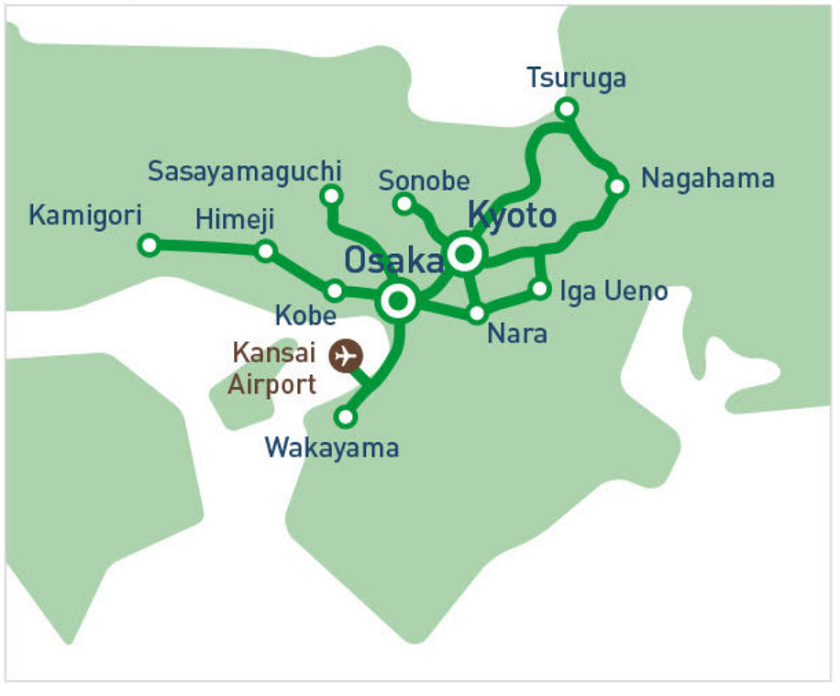
Available for 1, 2, 3 or 4 days, the Kansai Area Pass is the entry-level option for exploring the major Kansai cities — Kyoto, Osaka, Kobe, Himeji, Nara and Wakayama. For visitors flying into or out of Kansai Airport, it's particularly useful because it covers the Hello Kitty HARUKA Express, making the airport transfer free on top of city travel.
Best for: Short stays concentrated within Kansai; flying into KIX; visitors who want a lower-cost pass for a focused itinerary.
See our dedicated post: The Kansai Area Pass Explained.
Kansai WIDE Area Pass
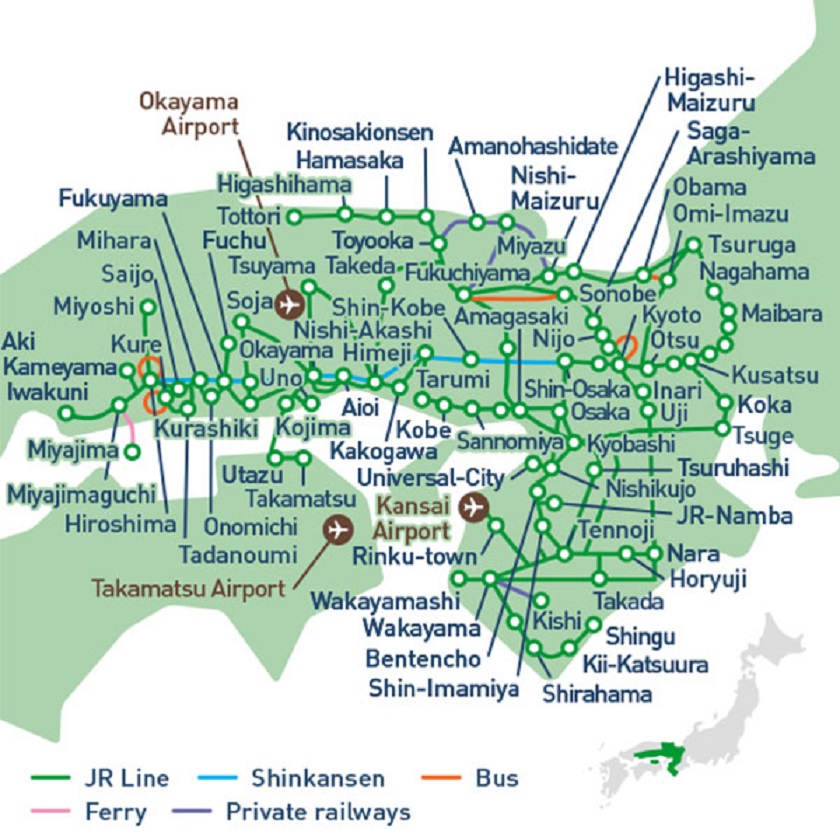
Valid for 5 consecutive days, this extends Kansai Area Pass coverage to include Okayama, Takamatsu, Kinosaki Onsen, Tottori and the Wakayama/Kii Peninsula. The extra reach makes it excellent for day trips from Kyoto or Osaka into destinations that are a stretch too far for the base Kansai pass. Riding the Shinkansen to Okayama, then crossing to Takamatsu in Shikoku, is one of the best itinerary add-ons this pass unlocks.
Best for: Visitors based in Kansai for 4–5 days who want to explore further afield.
Kansai – Hiroshima Area Pass
The most compelling single-route value proposition in the JR West lineup. It covers the Sanyo Shinkansen between Kansai and Hiroshima — and a return Shinkansen fare between Osaka and Hiroshima alone can exceed ¥18,000, making the pass pay for itself on that journey alone. Add visits to Himeji, Iwakuni and Onomichi and the value multiplies quickly.
Best for: Visitors to Kansai who want to include Hiroshima — or those arriving/departing Hiroshima while spending most of their time in Kansai.
Great value passes
JR Setouchi Area Pass
One of the most distinctive passes in the JR West range, for two reasons. First, it covers the full Sanyo Shinkansen from Shin-Osaka all the way to Hakata — making it one of the most cost-effective options for a return journey between Kansai and Fukuoka. Second, it includes a range of ferries and JR buses along the Seto Inland Sea, connecting the mainland to Shikoku and several small islands that even the Japan Rail Pass doesn't reach. If exploring the Seto Inland Sea — islands like Shodoshima, the Art Island at Naoshima or the slower coastal routes — is part of your plan, this pass is exceptional value.
Best for: Seto Inland Sea island-hopping; the most economical Kansai–Fukuoka connection with coastal detours.
Sanyo-San'in Area Pass
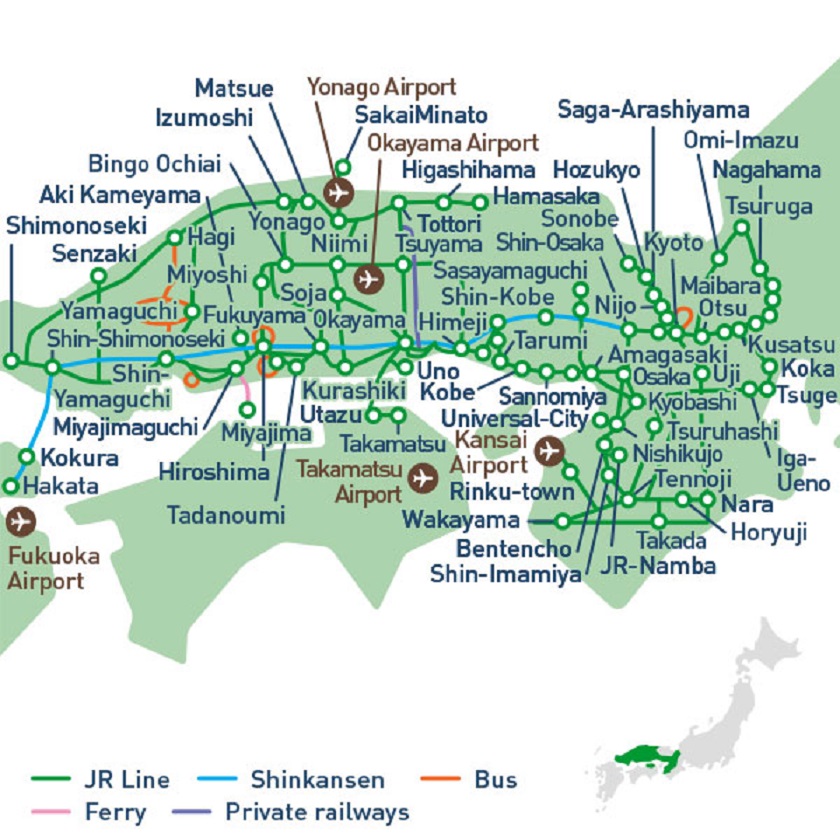
Valid for 7 consecutive days and covering the entire Sanyo and San'in coasts — this pass gives you the Sanyo Shinkansen (Shin-Osaka to Hakata), all JR West conventional lines across the Chugoku region, and free seat reservations on all Shinkansen and limited express services within the area. The seat reservation inclusion is notably generous compared to other JR West passes, most of which only allow non-reserved seating or charge extra for reservations.
Best for: Travellers spending a week exploring the west — Hiroshima, the San'in coast (Matsue, Tottori, Hagi), and the Sanyo corridor between Osaka and Fukuoka.
Sanyo-San'in–Northern Kyushu Pass
Extends the Sanyo-San'in Area Pass southward to include northern Kyushu — adding Beppu, Yufuin, Nagasaki and Kumamoto to a coverage area that already includes Hiroshima, Tottori and everything in between. The price premium over the base Sanyo-San'in pass is small relative to what a Kyushu extension costs in individual tickets.
Best for: When the Sanyo-San'in coverage isn't quite enough and you want a day or two in Kyushu.
Kansai–Hokuriku Area Pass
Valid for 7 days, this pairs the Kansai Wide Pass coverage with travel up the Hokuriku corridor to Kanazawa and Toyama (but not Takayama — that requires a separate journey). A strong value proposition for itineraries that combine Kyoto or Osaka with Kanazawa, which is one of Japan's most rewarding medium-size cities and often overlooked by first-time visitors following the Golden Route.
Best for: Kansai + Kanazawa itineraries; the Japan Sea coast between Tsuruga and Toyama.
Niche passes
Hiroshima–Yamaguchi Area Pass
Covers travel between Fukuoka (Hakata) and Hiroshima. Purpose-built for travellers entering or departing via Hakata who want to work their way up through western Honshu to Hiroshima, Onomichi and the San'in area (Hagi, Izumo).
Best for: Arriving in Fukuoka and heading northeast to Hiroshima; Hakata-based itineraries exploring the Sanyo coast.
Sanin-Okayama Area Pass (Check current availability)
Coverage from Okayama into the San'in region — Hagi, Izumo, Matsue and beyond. At time of writing, this pass has been listed as temporarily unavailable; check the current status at jrpass.com/regional-passes before planning.
Hokuriku Area Pass
A compact pass for the Hokuriku area alone — Kanazawa, Wakura Onsen, Tsuruga and surrounding stops. Most useful in conjunction with another Kansai pass, or for visitors already positioned in Hokuriku who want a few days of flexible travel within the region.
JR-WEST Online Train Reservation
JR-WEST ONLINE TRAIN RESERVATION allows pass holders to reserve seats from one month before boarding, opening at 10:00 AM Japan Standard Time on the same date of the preceding month. You can make up to 9 seat reservations in advance for the Sanyo-San'in Area Pass through the system; holders of passes purchased through overseas travel agents must make reservations at a JR West ticket office after arriving in Japan.
Once you've activated your JR West pass, you have several options for making free seat reservations:
1 — JR-WEST Online Train Reservation
JR West's official online reservation system at www.westjr.co.jp allows you to pre-book seats on Shinkansen and limited express services covered by your pass. An advantage of purchasing through the official JR West website is that you can make seat reservations online before arriving in Japan; those who purchased through a travel agent can make reservations only at ticket machines or ticket offices after arrival.
2 — JR West ticket offices (Midori-no-Madoguchi)
The staffed ticket counters at all major JR West stations accept seat reservations for pass holders at no charge. This is the most reliable option for first-time visitors or complex reservations. Staff at major stations (Kyoto, Shin-Osaka, Osaka, Hiroshima, Hakata) are experienced with international visitors.
3 — Green ticket machines
Most JR West passes allow up to six seat reservations at the green automated ticket machines. After the first six, subsequent reservations must be made at ticket offices.
Practical notes:
- Free seat reservations are included with the Sanyo-San'in Area Pass, the Sanyo-San'in–Northern Kyushu Pass and the JR-WEST All Area Pass. Other passes may restrict reservations or charge an extra fee — check the specific pass conditions.
- Seat availability on popular Shinkansen routes (especially between Osaka and Hiroshima) can be limited during Golden Week, Obon and New Year. Book as early as your pass purchase date allows.
- You must carry your passport at all times when using a JR West pass, as staff may request to see it alongside the pass.
Frequently Asked Questions (FAQ)
1. What is the JR West All Area Pass price?
The JR-WEST All Area Pass costs ¥26,000 for adults and ¥13,000 for children aged 6–11, valid for 7 consecutive days. It covers the entire JR West service area including the Sanyo Shinkansen (Shin-Osaka to Hakata), the Hokuriku Shinkansen (Tsuruga to Joetsu-Myoko), all JR West conventional lines, the JR West Miyajima Ferry, and reserved seats on limited express trains. Prices are subject to change — verify current pricing before purchase.
2. How do I make a seat reservation with my JR West pass?
Reservations are accepted via JR-WEST ONLINE TRAIN RESERVATION from one month before boarding, opening at 10:00 AM JST on the same day of the preceding month. After arriving in Japan, you can also reserve seats free of charge at any JR West ticket office or at green ticket machines (up to six reservations at machines; subsequent reservations at ticket offices only). Your pass and passport are required.
3. Can I use a JR West pass on the Nozomi Shinkansen?
On the Sanyo Shinkansen section (Shin-Osaka to Hakata), yes — several JR West passes including the Sanyo-San'in Area Pass and the JR-WEST All Area Pass are valid on Nozomi and Mizuho services. This is a significant advantage over the standard Japan Rail Pass, which does not cover Nozomi. However, the Tokaido Shinkansen (Tokyo to Shin-Osaka) is not covered by any JR West pass.
4. What's the difference between the Kansai Area Pass and the JR-WEST All Area Pass?
The Kansai Area Pass is shorter (1–4 days) and covers only the Kansai region — Kyoto, Osaka, Kobe, Himeji, Nara — without any Shinkansen between major cities. The JR-WEST All Area Pass covers the entire JR West network for 7 days, including the full Sanyo Shinkansen corridor to Fukuoka and the Hokuriku Shinkansen north toward Kanazawa. Choose the Kansai Area Pass for a short Kansai-focused trip; choose the All Area Pass for a wider western Japan itinerary.
5. Is the JR West pass worth it compared to the Japan Rail Pass?
For itineraries entirely within western Japan, a JR West pass will almost always be cheaper than the 7-day Japan Rail Pass. The key question is whether your trip also includes Tokyo or central Japan — if it does, the nationwide pass is usually better value. Use our JR Fare Calculator to compare costs for your specific route.


.jpg)