Japan has no shortage of mountain destinations for international visitors to discover, but one of the most iconic mountain experiences in Japan is the Tateyama Kurobe Alpine Route. This remarkable journey through the Japanese Alps takes visitors through valleys, up mountains, and past all manner of breathtaking scenery.
But what makes the Kurobe Alpine Route so memorable is all the different modes of transport that link together to make this journey possible. Read on to see how you too can experience the Tateyama Kurobe Alpine Route when you next visit Japan using the Japan Rail Pass.
Background to the Tateyama Kurobe Alpine Route
The Tateyama Kurobe Alpine Route is a specially designed sightseeing route that connects through the Japanese Alps from Tateyama near Toyama to Omachi near Nagano. This remarkable seasonal route stretches for around 90 kilometres through the mountains and first opened back in 1971.
What makes travelling the Kurobe Alpine Route possible is a jumble of different modes of transport, from buses and trains to cable cars, that connect Tateyama with Omachi. The Alpine Route between Tateyama and Ogizawa is made up of six connecting modes of transport, with a private railway (the Toyama Chiho Railway) at the Toyama end and local buses at the Nagano end completing the journey — eight legs in total. With a single through-ticket, it's possible to travel across the route in a single day, while some choose to take their time exploring the so-called “Roof of Japan.”
Travelling across the route, tourists will have the chance to see a variety of different landscapes and alpine attractions, including the iconic Tateyama snow corridor. That said, several sections of the route are entirely underground, meaning it’s often the stops where the majority of the sightseeing takes place.
Transport Along the Kurobe Alpine Route
So that you can fully appreciate how interesting and varied travel on the Kurobe Alpine Route is, let’s look at each form of transport you’ll take across the full route, travelling west to east.
Toyama Chiho Railway (65 minutes): This train takes you from Dentetsu Toyama Station, just by Toyama Station, out to Tateyama Station near the start of the mountains.
Tateyama Cablecar (7 minutes): Rise higher and higher out of Tateyama Station on this cable car that climbs 500 metres at a 24 degree gradient to Bijodaira Station.
Tateyama Highland Bus (50 minutes): Travel further up into the alps aboard this bus from Bijodaira Station, past the Midagahara Wetlands to Murodo. It’s here in spring that you can pass through the famous Tateyama Snow Corridor.
Tateyama Tunnel Electric Bus (10 minutes): Passing through a tunnel that connects Murodo with Daikanbo, this section switched to battery-electric buses from the 2025 season, replacing what had been Japan's last trolleybus. It runs at around 2,450 m — the highest-elevation bus service in Japan.
Tateyama Ropeway (7 minutes): Enjoy panoramic views from this 1.7-kilometer-long ropeway between Daikanbo and Kurobedaira, which is the longest in Japan with just one span.
Kurobe Cablecar (5 minutes): This short cable car surprisingly operates completely underground between Kurobedaira and Kurobe Dam.
Kanden Tunnel Electric Bus (16 minutes): Another electric tunnel bus, this service takes you from Kurobe Dam to Ogizawa.
Ogizawa Buses (40 minutes / 100 minutes): Choice of two bus connections out of Ogizawa to JR stations. The Ogizawa-Omachi Local Bus runs to Shinano-Omachi Station and takes 40 minutes. Alternatively, the Nagano Express bus runs from Ogizawa to Nagano Station and takes 100 minutes.
Things to Do on the Kurobe Alpine Route
With the transport side of things out of the way, let’s look at all the great sights and places to visit that sit along the Kurobe Alpine Route.
Tateyama Snow Corridor
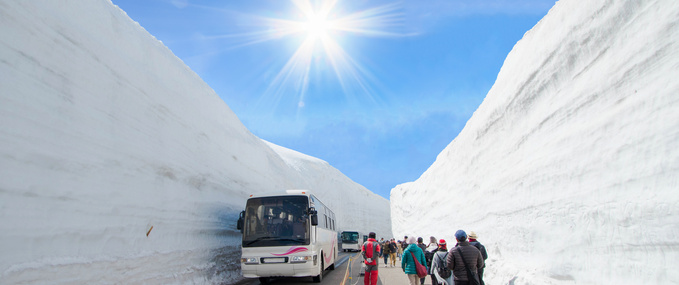
By far the most famous place to visit on the Kurobe Alpine Route is the iconic snow corridor that forms each spring. Each April and May, the road between Bijodaira and Murodo is cleared and opened up, leaving stunning walls of snow on either side like a corridor. These walls can reach heights of 20 metres and stretch for one kilometre, depending on the snowfall earlier in the year.
Besides passing through the corridor on the bus, there is also a section open to pedestrians up near the Murodo Bus Terminal. Seeing the incredible snow corridor helps explain why the route only opens up each year in April. Often, the snow walls will survive into mid-to-late June before melting away.
Murodo Hiking
The top of Murodo Mountain is the main hub for visitors to the Tateyama Kurobe Alpine Route, offering facilities like a hotel, conservation centre and onsen. But one of the most popular activities related to this 2450-metre-high mountain is that it’s the start point for a variety of local hiking trails. Popular hikes here include trips up to the summits of Mt. Tateyama, as well as other nearby mountains like Mt. Murodo and Mt. Jodo, all of which offer great views of the Tateyama Mountain Range.
Midagahara Wetlands
One of the more interesting landscapes to explore here among the Japanese Alps is the Midagahara wetlands. Spanning across a plateau at 1930 metres above sea level, this marsh is a great spot in the warmer months of the year for nature walks along its many boardwalks. Then there’s Midagahara in autumn, when everything changes colour and completely transforms the landscape yet again.
Shomyo Falls
Being in the mountains with plenty of melting snow, it’s only natural that you find some waterfalls in the Japanese Alps. However, you may be surprised to learn that the Alpine Route is home to the tallest waterfall in Japan, Shomyo Falls. This monumental waterfall measures 350 metres in height, with four different tiers that you can see from its viewpoints. Reaching the falls is possible via a special bus out of Tateyama Station.
Transfer Station Viewpoints
One of the benefits of switching modes of transport along the Alpine Route is the chance to stop at each of the transfer stations. While they may not sound too glamorous, many of the transfer stations boast incredible views from their observation decks.
Take the Daikanbo stop between the Tateyama Tunnel Electric Bus and Tateyama Ropeway, for example. Sitting at 2,316 metres elevation, the station has a rooftop observation deck with a sweeping panorama of the Japanese Alps and Lake Kurobe below. The same goes for the Kurobedaira transfer station further along and its stellar mountain views.
Kurobe Dam
Another transfer stop that deserves special mention is Kurobe Dam because it offers some special sightseeing opportunities. The tallest dam in Japan at 186 metres in height, Kurobe Dam powers a local hydro plant and makes for a particularly imposing sight along the Alpine Route. Visitors will want to tackle the 200-plus steps up its long staircase to enjoy superb views of the dam from its dedicated observation deck.
Tickets for the Kurobe Alpine Route
As you are not able to travel on the Kurobe Alpine Route using your JR Pass, it’s worth understanding a few things about the tickets you need:
General tickets for the Kurobe Alpine Route provide a one-way trip across the route, although there are some shorter round-trip tickets also available.
Tickets can be bought in advance online or on the day at Tateyama and Ogizawa Stations, but not Shinano-Omachi Station. Tickets bought in person are valid for five days after the purchase date.
A general one-way ticket from Toyama to Ogizawa is approximately ¥10,530, while one from Toyama to Shinano-Omachi is around ¥11,920 — but these fares change periodically, so check the official Alpine Route site for the current prices before you travel.
There are also special tourist passes that include the Alpine Route among other places, such as the Alpine-Takayama-Matsumoto Area Tourist Pass and the JR Central “Tateyama Kurobe Alpine Ticket”.
Some forms of transport, such as the Tateyama Cable Car and the Kanden Tunnel Electric Bus, come with an allocated departure time. Reserving a specific time for the Tateyama Cable Car is also possible on the official site.
Information for Travelling the Kurobe Alpine Route
The full route from Dentetsu Toyama to Shinano-Omachi is typically open from around 15 April to 30 November (in 2026, for example, it runs 15 April–30 November), with a partial section between Dentetsu Toyama and Midagahara often opening a little earlier, around 10 April. Exact dates vary each year, so check the official site. Outside this window, the route is closed for winter.
While it’s possible to briefly cover the entire Alpine Route in a day trip with the full route taking around 6-7 hours, you’ll get more from the experience and see more if you allow several days here. Accommodation is available along the route, mostly in Murodo.
Timetables for all the different modes of transport can be found here.
So that you don’t have to worry about your luggage as you explore the Alpine Route, there are baggage forwarding services available in the area, not to mention luggage lockers back in cities like Tokyo.
Getting to the Kurobe Alpine Route with the JR Pass
While we’ve covered what it’s like to travel along the Kurobe Alpine Route, there’s still the matter of getting to it in the first place. The good news is that it’s possible to reach either end of the route using your Japan Rail Pass.
Starting at Toyama
To start the route at Toyama, you can take the Hokuriku Shinkansen from Tokyo Station all the way to Toyama Station. From there, it's a very short walk to Dentetsu Toyama Station, where the route begins. The JR Pass covers you as far as Toyama (the Tokyo–Toyama shinkansen leg takes about 2–2½ hours), but note that the Toyama Chiho Railway from Dentetsu Toyama to Tateyama is a private line — it isn't covered by the JR Pass, and is instead included in your Alpine Route ticket.
Starting around Nagano
For the start at the other end of the route, you have a choice of either travelling to Shinano-Omachi or Ogizawa.
To reach Shinano-Omachi Station, you can take the Azusa limited express from Shinjuku to Matsumoto, followed by the Oito Line to Shinano-Omachi. This trip is fully covered by the JR Pass, but it does mean you will arrive at Shinano-Omachi, where you cannot purchase Kurobe Alpine Route tickets.
The alternative is to travel on the Hokuriku Shinkansen from Tokyo Station to Nagano, then take the express bus from Nagano to Ogizawa. Only the Shinkansen journey will be covered by your JR Pass here. Both of these options take around 3 ½ hours to reach from Tokyo.
FAQ
1. Is the Tateyama Kurobe Alpine Route covered by the JR Pass?
No. The Alpine Route is a separate, paid sightseeing route with its own ticket. Your JR Pass covers getting to the route — to Toyama on one side, or to Shinano-Omachi on the other — but not the route itself, nor the private Toyama Chiho Railway or the Ogizawa connecting buses.
2. When is the Alpine Route open?
It's a seasonal route, typically open from around 15 April to 30 November, and closed through winter. Exact opening and closing dates vary each year, so check the official site. The pedestrian section of the snow wall near Murodo is usually open from mid-April to around late June.
3. How high is the snow wall?
The famous snow corridor (Yuki-no-Otani) near Murodo can reach around 20 metres, though the exact height depends on each winter's snowfall.
4. How long does it take to cross the Alpine Route?
Travelling the full route end to end takes roughly 6–7 hours including sightseeing stops, so it's possible as a long day trip — but staying overnight (for example at Murodo) lets you see much more.
5. How do you get to the Alpine Route?
From Tokyo, take the Hokuriku Shinkansen to Toyama (covered by the JR Pass) for the western end, or reach the eastern end via Shinano-Omachi (JR to Matsumoto, then the Oito Line) or via a bus from Nagano to Ogizawa. Note that tickets can't be bought at Shinano-Omachi Station itself.
Daniel -San
Daniel-San, is a household name at JRPass.com. Daniel-san has shared his rich travel experience for nearly 10 years on the community forum. Ask him for anything related to travel in Japan!
Découvrez où acheter la carte d'abonnement ferroviaire japonaise en ligne.
Commandez votre forfait JR Pass dès maintenant !
Nous offrons des tarifs spéciaux pour les enfants et d’excellentes options de première classe. Voir tous les tickets. Ou voir notre gamme de Pass régionaux


 English
 Deutsch
 Español
 Italiano
 Nederlands
 Português
 日本語
日本語 한국어
한국어 简体中文
简体中文 繁體中文
繁體中文


.png)