Deutsch
 Español
 Français
 Italiano
 Nederlands
 Português
 日本語
日本語 한국어
한국어 简体中文
简体中文 繁體中文
繁體中文
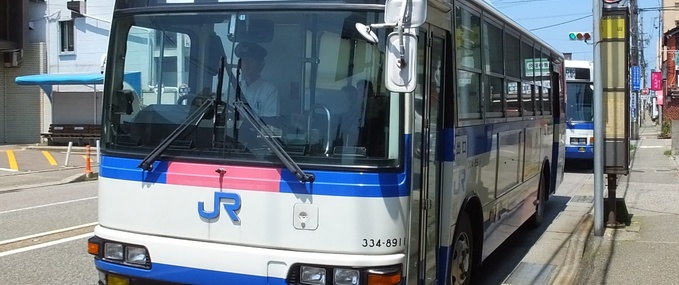


To ride a Japanese city bus, board at the rear door (front in Tokyo), tap your Suica/PASMO/ICOCA IC card on the reader or take a numbered ticket if paying cash. Press the yellow button before your stop, then tap your card again or drop the exact fare in the box by the driver as you exit through the front door. In most cities the fare is between ¥200–¥250 per ride. Your Japan Rail Pass covers JR local buses in many regions — show it to the driver instead of paying.
Buses are one of the most useful — and often the most overlooked — ways to explore Japan. They reach the spots trains can't (think hillside temples in Kyoto, neighbourhoods in Hiroshima, scenic mountain villages around Nagano), they're remarkably cheap, and once you know the system they're as efficient as everything else in Japan. Your Japan Rail Pass even covers travel on JR local buses, making it even better value than most visitors realise.
This guide walks you through everything: how to pay, how to board, what's covered by your JR Pass, useful passes for sightseeing, and how to use a bus to get from your arrival airport into town.
Which buses are covered by JRPASS
The Japan Rail Pass covers JR local buses across the country — look for the JR logo on the bus and on the bus stop. Sadly, JR highway buses are not covered (they used to be partially included, but this changed years ago). Before boarding, glance at the bus and the stop signage: if you can see the JR logo and it's not a long-distance highway service, your pass is valid.
JR local buses operate in many regions of Japan, including parts of Hokkaido (Sapporo and surrounds), Tohoku (Aomori, Iwate, Fukushima), Kanto (around Tokyo and the surrounding prefectures), Chubu (Nagano, Gunma), Kansai (Kanazawa, Kyoto, Shiga, Fukui), Chugoku (Hiroshima, Yamaguchi), Shikoku (Kochi, Ehime) and Kyushu (Fukuoka, Saga, Kagoshima). The official JR Pass website maintains a current list of covered routes here — always worth a quick check for the specific route you're planning.
For everything else — Toei buses in Tokyo, Kyoto City Buses, the Hiroshima Meipuru-pu loop, and most local city buses — you'll need to pay separately. The good news is that they're all very affordable.
Paying for the Bus: IC Cards, Cash and JR Pass
There are three ways to pay for a Japanese city bus, and one of them is dramatically easier than the others. Here's the lay of the land.
1. IC card (the easy way)
Suica, PASMO, ICOCA, Kitaca, TOICA, manaca, SUGOCA — any of Japan's rechargeable transit IC cards work on virtually every city bus in the country. Just tap your card on the reader as you board (or as you alight, depending on the city — more on this below), and the correct fare is deducted automatically. No tickets, no fumbling for coins, no working out fares from the display. If you only do one thing before riding a Japanese bus, get an IC card. You can buy a Welcome Suica or PASMO Passport at the airport on arrival, or load Suica/PASMO directly onto your iPhone or Apple Watch (Android works too with Mobile Suica).
2. Cash
If you don't have an IC card yet, no problem — every Japanese city bus still accepts cash. You'll either grab a numbered ticket as you board (in cities where fares vary by distance) or simply drop the flat fare in the fare box by the driver as you leave. There's a change machine next to the driver that breaks ¥1,000 notes into coins. Notes larger than ¥1,000 are usually not accepted — break those at a convenience store before boarding.
3. Japan Rail Pass
On any JR local bus, simply show your pass to the driver as you exit (or as you board in flat-rate systems). No payment, no scan, no ticket — just show and go. Always confirm it's a JR-branded bus before boarding.
Step-by-Step: How to Ride a City Bus
- Board at the rear door of the bus (front in Tokyo and some other cities — see exceptions below)
- Tap your IC card on the reader as you board, OR take a numbered ticket from the machine by the door if paying cash
- The electronic display by the driver shows the current and next stops, plus the fare for each ticket number. Match your ticket number to the display to see your current fare.
- When your stop is approaching, press the illuminated yellow とまります ("I'm getting off") button. You'll find these on seat backs and along the walls.
- As the bus slows, gather your fare or get your IC card ready.
- Exit at the front door. Tap your IC card on the reader, drop the exact fare into the box by the driver, or — if you have a JR Pass — simply show it.
If you don't have the correct change, use the change machine by the driver to break a ¥1,000 note into coins before you pay.
Fares vary from city to city. Most cities use either a flat rate (the same fare regardless of distance) or a distance-based system (fare increases the further you ride).
Sightseeing Bus Passes Worth Knowing
For cities where you'll be using the bus frequently, a day pass typically pays for itself in 3–4 rides.
Kyoto Subway & Bus 1-Day Pass — ¥1,100 adult / ¥550 child. Covers all Kyoto City Bus routes, all Kyoto City Subway lines, plus Kyoto Bus, Keihan Bus and West Japan JR Bus on most routes — easily the best value for visitors covering Kinkaku-ji, Kiyomizu-dera, Arashiyama and Gion in a single day.
Kyoto City Bus & Kyoto Bus 1-Day Pass — ¥600 adult. Unlimited travel for one day on Kyoto City Bus and Kyoto Bus routes within the flat-fare zone. Lower price than the combined pass but doesn't cover the subway.
Hiroshima Meipuru-pu Sightseeing Loop Bus Day Pass — ¥600. Unlimited rides on the orange, green and lemon Hiroshima sightseeing routes that connect Hiroshima Station, Peace Park, Hiroshima Castle and Shukkeien Garden. See our full guide: Using the JR Pass on the Hiroshima Sightseeing City Bus.
Tokyo Toei One-Day Pass — ¥700. Unlimited Toei bus rides within Tokyo's 23 wards for one day. Useful if you're staying in central Tokyo and planning bus-heavy sightseeing.
Catching a City Bus from Japan's Main Entry Airports
If you're researching the cheapest city to fly into Japan, your decision usually comes down to a handful of airports: Tokyo (Haneda or Narita), Osaka (Kansai International), Fukuoka, and increasingly Sapporo or Naha. Once you've landed, the bus systems at each are well worth knowing — they're often the cheapest and most luggage-friendly way into the city.
Haneda Airport (Tokyo) — Haneda offers one of the cheapest overall airfares of any Japanese airport, averaging around $205 round trip from the US in recent data, and sits just south of central Tokyo on Tokyo Bay. Tokyo Airport Bus runs limousine services from Haneda to most central Tokyo districts and major hotels (¥1,400–¥1,800). For local Toei city buses around Haneda, fares are ¥210 flat.
Narita Airport (Tokyo) — Further from central Tokyo, but consistently competitive on price. The Tokyo Airport Bus from Narita reaches Tokyo Station for ¥1,500. Once in Tokyo, the Toei bus network covers the city's 23 wards comprehensively.
Kansai International (Osaka) — Kansai offers the second-lowest average airfare of any Japanese airport from the US, and is the main hub for budget carrier Peach Aviation. Kansai Airport Limousine Buses serve Osaka, Kyoto, Kobe and Nara at fares between ¥1,300–¥2,600. Once in Osaka or Kyoto, switch to the local city bus systems as described above.
Fukuoka Airport — Remarkably central for an international airport: just 13 km from the heart of Fukuoka city. The subway reaches Hakata Station in 5 minutes, but the local Nishitetsu bus network is your friend once you're in town, with flat fares of ¥150 within the city centre.
Sapporo New Chitose — The JR Rapid Airport train reaches Sapporo Station in 37 minutes for about ¥1,150, covered by the Japan Rail Pass. From Sapporo Station, the local bus network is extensive and inexpensive.
A practical note for all five: your Japan Rail Pass doesn't cover airport limousine buses (these are highway services), but it does cover the JR trains and JR local buses you'll use to get around your destination city afterwards.
3 Traveller Tips
Tip 1 — Get an IC card before you board your first bus
The single best thing you can do for stress-free bus rides in Japan is pick up an IC card on arrival. Any Japanese IC card works on virtually all city buses — ICOCA, Suica, PASMO, Kansai One Pass, PiTaPa. Welcome Suica (for short-term visitors) is available at major Tokyo airports and stations. You can also load Suica onto your phone (iPhone and most Android models) — meaning no card to lose. See our guide: Where to Buy a Suica Card.
Tip 2 — Save your destination on Google Maps before you board
Google Maps in Japan is excellent and shows real-time bus information, including which stop to board at, the bus number, the arrival platform, and how many stops until you get off. Drop a pin on your destination and let it guide you — even when the bus's announcement system isn't in English, your phone will be. A Pocket WiFi makes this seamless.
Tip 3 — In Kyoto, consider the bus and the subway
Kyoto's city bus is iconic but the central buses can get extremely packed during peak hours (and during cherry blossom and autumn leaves season). For longer cross-city journeys, the Kyoto subway is faster and reliably less crowded. The Subway & Bus 1-Day Pass covers both and is genuine value if you'll do more than four rides.
Frequently Asked Questions (FAQ)
1. Can I use my Japan Rail Pass on city buses?
Yes, on JR local buses — look for the JR logo on the vehicle and the stop. JR highway buses are not covered. The official JR Pass website maintains a current list of covered routes. Show your pass to the driver as you exit (or board, on flat-fare buses) instead of paying.
2. How much is a Kyoto city bus ride?
¥230 for adults and ¥120 for children within the flat-fare zone, which covers most major tourist areas. The Sightseeing Limited Express buses (EX100 and EX101) cost ¥500. Outside the flat-fare zone, fares are distance-based. For frequent bus use, the ¥1,100 Subway & Bus 1-Day Pass pays for itself quickly.
3. Can I pay for a bus with Suica or PASMO?
Yes — Suica, PASMO, ICOCA and other Japanese IC cards work on virtually every city bus in Japan. Tap on as you board (or off if using a flat-fare bus) and the correct fare is deducted automatically. It's the easiest and most stress-free way to ride.
4. What's the cheapest city to fly into in Japan?
Recent data shows Tokyo Haneda offering the cheapest overall flights to Japan, with Osaka Kansai second, followed by Fukuoka. Average fares from the US to Haneda hover around $205, with Kansai around $396. All three airports have excellent bus and rail connections into their respective city centres, so any of them works well as an entry point — your choice often comes down to which region you want to explore first.
5. Which door do I board through?
In most Japanese cities (Kyoto, Hiroshima, Osaka and elsewhere) you board through the rear door and pay/tap as you exit through the front. The major exception is Tokyo's Toei buses, where you board through the front, pay or tap immediately, and alight through the rear. When in doubt, watch the locals.
6. Do I need exact change for the bus?
You need exact change in the fare box, but every Japanese bus has a change machine next to the driver that breaks ¥1,000 notes into coins. Anything bigger than ¥1,000 typically won't be accepted — break those at a convenience store before boarding. Or save yourself the hassle entirely with an IC card.
.png)