English
 Deutsch
 Español
 Français
 Italiano
 Nederlands
 Português
 日本語
日本語 한국어
한국어 简体中文
简体中文
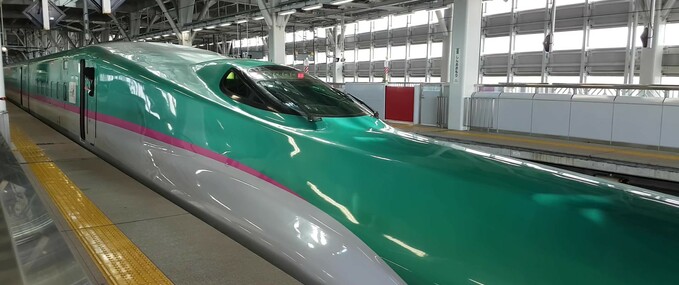


The Tohoku Shinkansen is Japan's longest bullet train line, running about 675 km from Tokyo up to Shin-Aomori at the northern tip of Honshu, operated by JR East. It's home to the Hayabusa — the fastest train in Japan at 320 km/h — and connects onward to Hokkaido (Hakodate) and, via two mini-Shinkansen branches, to Akita and Yamagata. It's your gateway to northern Japan: Sendai, the temples of Hiraizumi, the festivals of Aomori, and the snows of Hokkaido. The whole line is covered by the Japan Rail Pass (a free seat reservation is required on some trains).
If you're heading anywhere north of Tokyo, the Tohoku Shinkansen is the train you'll want. In plain terms: it's the fast, comfortable bullet train spine that runs up the entire northeast of Japan's main island, opening up a region many visitors never reach — and it's home to Japan's speed king, the sleek green Hayabusa.
Table of contents:
A bit of background on the Tohoku Shinkansen
The Tohoku Shinkansen is the high-speed Shinkansen rail line between Tokyo and Aomori, covering a distance of nearly 675 km (420 miles), and is operated by JR-East. The Tohoku Shinkansen connects with the Hokkaido Shinkansen in the north and also has two mini-Shinkansen branch lines, the Yamagata Shinkansen and Akita Shinkansen. Major stops along the route include Sendai, Morioka and Hachinohe.
The Route
The Tohoku Shinkansen (東北新幹線) takes its name from the Tohoku region — the northeast of Honshu — and runs the entire way from Tokyo to Shin-Aomori, covering nearly 675 km (420 miles). That makes it the longest Shinkansen line in Japan. The first section opened in 1982, and the line was finally extended all the way to Shin-Aomori in 2010.
At its northern end, it connects seamlessly with the Hokkaido Shinkansen, which continues under the sea through the Seikan Tunnel to Shin-Hakodate-Hokuto on the island of Hokkaido (and will eventually reach Sapporo, currently planned for around 2030–31). Along the way, it also feeds two mini-Shinkansen branch lines: the Akita Shinkansen and the Yamagata Shinkansen, which leave the main line and continue on regular tracks to those cities.
Major stops along the main line include Ueno, Omiya, Sendai, Morioka, Hachinohe, and Shin-Aomori.
Trains on the Tohoku Shinkansen
Hayabusa
The Hayabusa Shinkansen service is the fastest Shinkansen on the Tohoku Shinkansen and the fastest Shinkansen service in Japan, reaching speeds up to 320km/h (scheduled to be upped to 360km/h by 2022). The Hayabusa only stops at the most important stations on the route, such as Sendai and Morioka. The Hayabusa continues service after Shin-Aomori on the Hokkaido Shinkansen line to Hakodate. The Hayabusa Shinkansen is free with the Japan Rail Pass, but you do need to make a complimentary seat reservation in advance.
Hayate
Only slightly slower than the Hayabusa Shinkansen, the Hayate Shinkansen stops at all major stations between Tokyo and Shin-Aomori. A small number of Hayate services also continue to Hakodate.
Yamabiko
This train service runs between Tokyo and Morioka on the Tohoku Shinkansen and stops at most stations.
Nasuno
The Nasuno Shinkansen train service runs between Tokyo and Koriyama and stops at all stations on the route.
Komachi
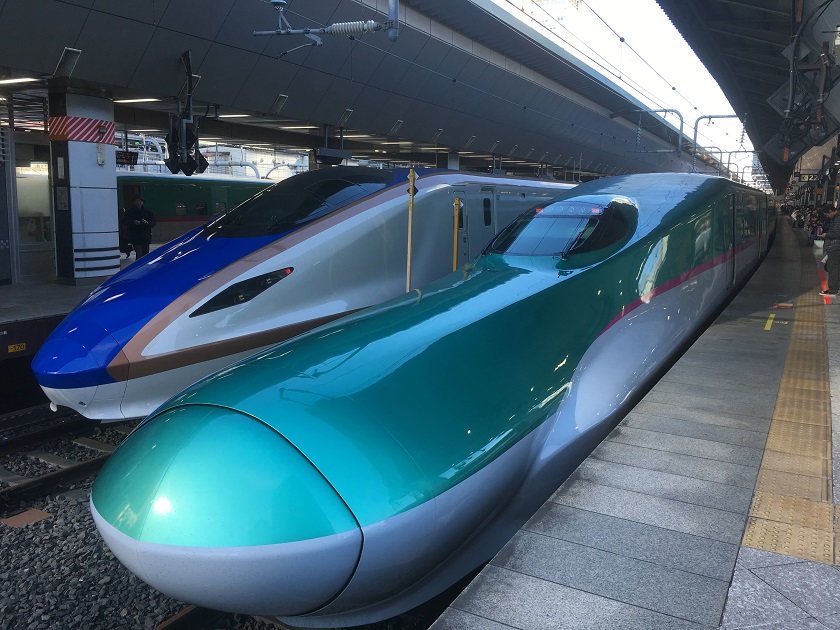
The Komachi is a high-speed service connecting Tokyo to Akita, often coupled to the Hayabusa Shinkansen to Morioka, from where the Komachi splits off and continues to Akita station.
Tsubasa
The Tsubasa Shinkansen runs on the Tohoku Shinkansen line until Fukushima, from where it runs on the Yamagata Shinkansen line to Shinjo.
Can I use the JR Pass on the Tohoku Shinkansen?
Yes, the entire Tohoku Shinkansen and all train services on the Tohoku Shinkansen are included in the Japan Rail Pass. Even the mighty fast Hayabusa Shinkansen train service is included.
Regional Passes on the Tohoku Shinkansen
In addition to the JR Pass, the JR East Tohoku pass and JR East – south Hokkaido Passes are valid on the entire Tohoku Shinkansen.
Map of the Tohoku Shinkansen
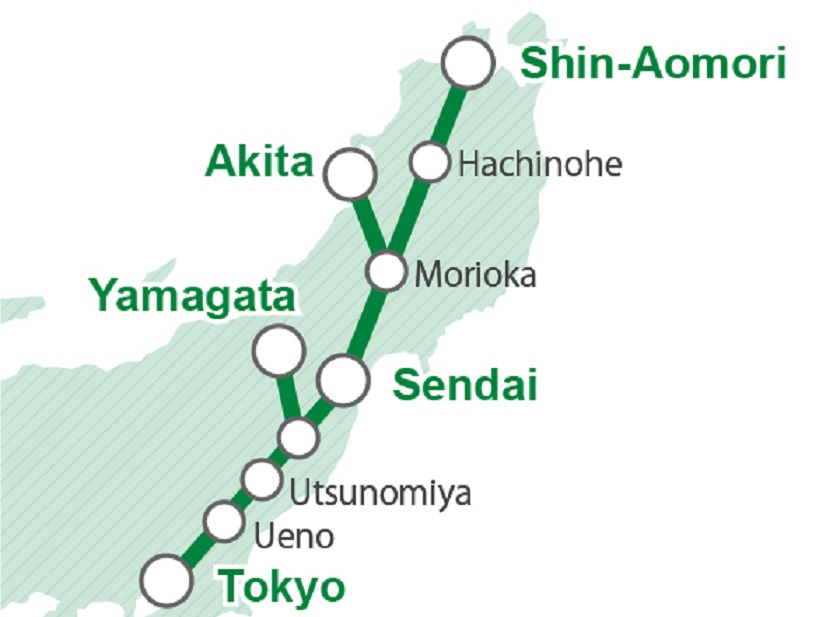
Map with the most important stations on the Tohoku Shinkansen
For a full JR Map, see our JR map page.
Gran Class and Green Class on the Tohoku Shinkansen
In addition to the ordinary class (2nd class), the Tohoku Shinkansen has Green seat (1st class) carriages and Gran Class carriages. The Green seats are operated on a 2×2 seat layout with extra reclining and space. On some train services on the Tohoku Shinkansen, free coffee, tea and water is served in Green Class, plus you get the free “oshibori” free hand towel service.
Gran Class is the most luxurious way of travel on the Shinkansen and is only available on the Tohoku and Hokuriku Shinkansen lines. Gran Class comes with its own dedicated Gran Class Attendant, bento box, snacks, drinks and even cocktails! Now that is travelling in style. We are working on an in depth article on Gran Class, so keep an eye out on the blog.
WiFi on the Tohoku Shinkansen
JR-East has begun to roll out free WiFi on the Tohoku Shinkansen since 2018, a gradual process that is set to be completed by 2020, in time for the Japan Olympics. We recommend using a Pocket WiFi if you want your personal high-speed hotspot.
Frequently Asked Questions
1. What is the fastest train on the Tohoku Shinkansen?
The Hayabusa, which runs at up to 320 km/h — the fastest scheduled train in Japan. It gets from Tokyo to Shin-Aomori in about 3 hours 10 minutes, stopping only at major stations. JR East is developing faster future trains (the E10 series and the Alpha-X testbed), but 320 km/h remains the current top speed.
3. How long does it take from Tokyo to Sendai on the Tohoku Shinkansen?
About 1 hour 30 minutes on the Hayabusa. Sendai is the largest city in the Tohoku region and makes an easy day trip from Tokyo or a great base for exploring northern Japan.
4. Can I take the Tohoku Shinkansen to Hokkaido?
Yes. The Hayabusa continues beyond Shin-Aomori onto the Hokkaido Shinkansen, travelling through the undersea Seikan Tunnel to Shin-Hakodate-Hokuto. Tokyo to Hakodate takes about 4 hours. From Shin-Hakodate-Hokuto, a short local train (the Hakodate Liner) takes you into Hakodate city.
5. Do I need a seat reservation for the Hayabusa?
Yes — the Hayabusa has no non-reserved seating, so a seat reservation is mandatory. It's free with your Japan Rail Pass; just make it at any JR ticket office or reservation machine before boarding. Standing tickets are sold only when all seats are booked.
6. What are the Komachi and Tsubasa trains?
They're services that run on the Tohoku Shinkansen's mini-Shinkansen branch lines. The Komachi splits off at Morioka to reach Akita, and the Tsubasa splits off at Fukushima to reach Yamagata. Both are often coupled to a main-line train for part of the journey, then separate — a fun sight at the splitting station.
7. What's the difference between the Hayabusa, Hayate and Yamabiko?
They differ in how many stops they make. The Hayabusa is fastest (fewest stops), the Hayate is almost as fast, and the Yamabiko makes more stops and is useful for smaller stations the fast trains skip. The Nasuno is the all-stops local service for the Tokyo commuter belt.
.png)